
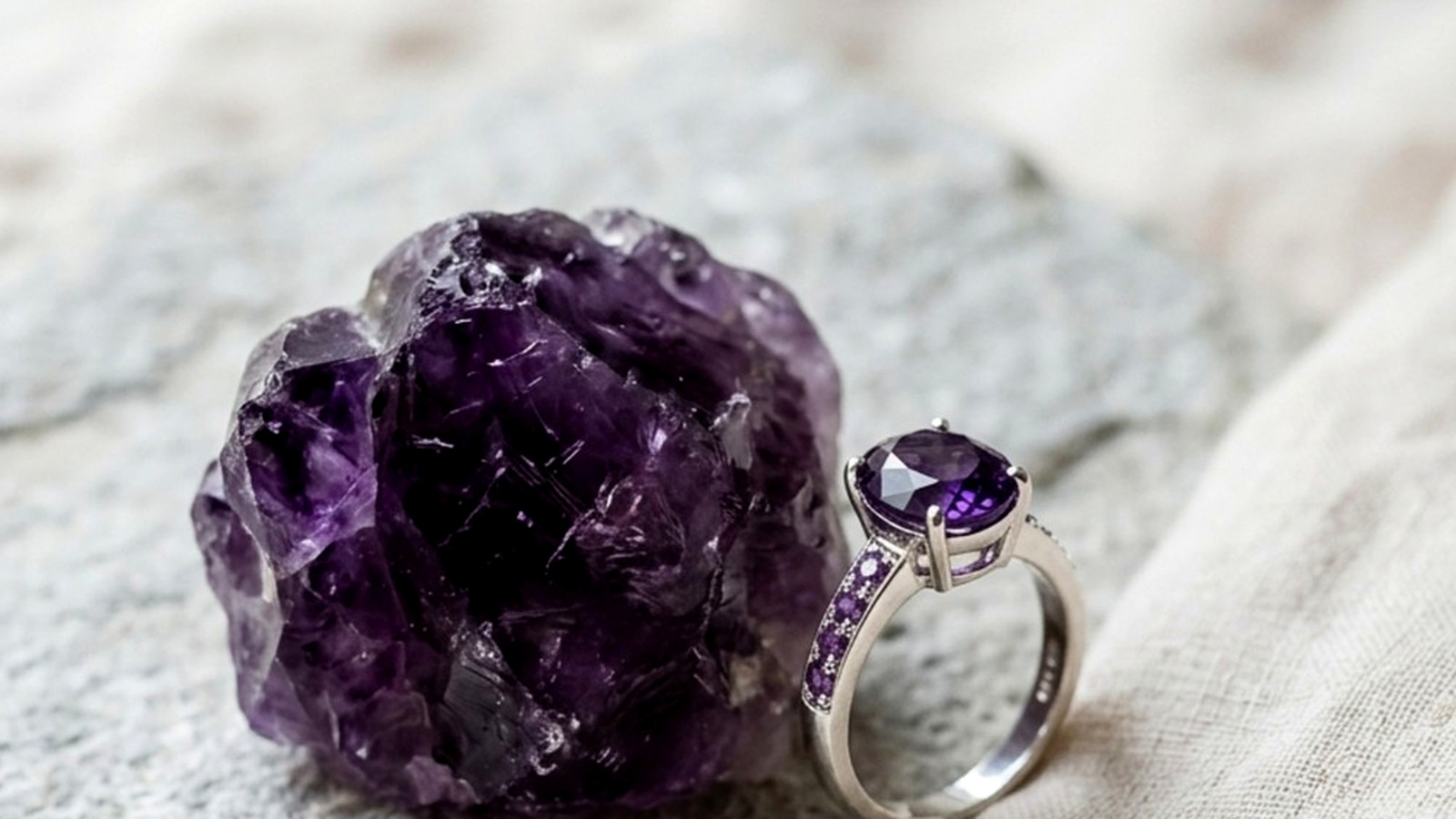
February’s birthstone is amethyst, the purple variety of quartz. Once as costly as ruby and emerald, it is now one of the easiest colored gems to buy well: it comes in every size, it is hard enough for rings, and big stones stay affordable. Still, listings use terms like “Siberian,” “Rose de France,” “heat treated” and “green amethyst” that are worth understanding before you buy.
This guide covers color and trade names, origins, treatments, lab-created stones, ametrine, green prasiolite, durability, metals and care, then ends with a checklist and seven pieces we checked live today. Shopping for more than one birthday? See our January birthstone guide to garnet and our November guide to topaz and citrine (citrine is amethyst’s yellow quartz cousin).
As an Amazon Associate I earn from qualifying purchases. Glimmerjam may also earn commissions from other retailers; see our affiliate disclosure.
Amethyst at a glance
- What it is: the purple variety of the mineral quartz (silicon dioxide). According to GIA, it is the most valued quartz variety.
- Hardness: 7 on the Mohs scale. GIA says that makes it suitable for daily wear in rings, though over the years it may show wear and need repolishing.
- Colors: light lilac to deep royal purple, from cool bluish purple to a reddish purple sometimes called “raspberry.” Amethyst often shows color zoning, meaning angular zones of lighter and darker purple (GIA amethyst description).
- Treatments: heat treatment is the most common one. Lab-created (synthetic) amethyst also exists and has been known since the 1970s.
- Meaning and lore: the name comes from the Greek amethystos, “not drunk.” GIA notes that St. Valentine was said to wear an amethyst ring carved with Cupid, and amethyst is the gem for the 6th and 17th wedding anniversaries.
Amethyst color: what matters and what the trade names mean
Color drives almost all of amethyst’s value. GIA’s amethyst quality factors describe the finest color as a strong reddish purple or purple with no visible color zoning. A stone that is too dark can look almost black in dim light, and brownish or bronze tints or obvious zoning lower value a lot.
“Siberian” amethyst
“Siberian” is a color grade, not a passport. The International Gem Society explains that the name first described top-quality stones from Siberia, a source now depleted. Today it is used for any amethyst with a deep purple color and red and blue flashes, wherever it was mined. GIA’s amethyst buyer’s guide adds that origin on its own does not add value to amethyst. Value is based on quality, and color is the most important factor regardless of country.
“Rose de France” amethyst
At the other end of the range, pale pinkish-violet or lilac amethyst is often called “Rose de France.” GIA’s buyer’s guide notes that pale colors are more affordable than strong reddish purple, and that visible inclusions reduce the value of pale stones greatly.
AAA, AA, A: not a standard
Many sellers grade amethyst as AAA, AA or A. GIA is clear that no standard quality-grading scale exists for amethyst. These letters are each company’s own system, so compare color descriptions and millimeter sizes instead.
Where amethyst comes from
GIA’s February birthstone page notes that Russia was the main source until large Brazilian deposits were found in the 19th century. Today the most important sources are in Africa and South America.
- Brazil is still a major supplier, especially its southernmost state, Rio Grande do Sul. Rough from there tends to be lighter in color, and some forms in geodes big enough to stand in.
- Uruguay, Bolivia and Zambia have all produced gem-quality amethyst more recently, according to the IGS.
- Zambia’s Kariba mine is one of the largest amethyst producers in the world. GIA notes that Zambian material can be a highly saturated raspberry color, and it tends to have more inclusions than Brazilian material.
- Bolivia’s Anahí mine is famous as the source of ametrine (more below).
- Arizona’s Four Peaks mine near Phoenix produces some fine dark purple and purplish-red crystals.
Treatments: heat, dye and fracture filling
- Heat is the main treatment. GIA calls heat treatment the most common technique for improving amethyst’s color. It can’t make pale amethyst darker, but it can lighten very dark stones and remove brownish tints, and the change is permanent.
- Heat can also change the gem entirely. Some amethyst turns yellow (citrine) when heated, excessive heat can remove the color completely, and heated stones may be slightly more brittle at sharp corners.
- Dye is a red flag in cheap material. GIA reports that low-quality, light-colored amethyst and even light quartz have been dyed purple.
- Fracture filling is rare. GIA notes that surface-reaching cracks are occasionally filled to improve apparent clarity.
- Read both the title and the spec table. A listing can say “natural amethyst” in the title and “heat treated” in the specs. Both can be true: natural means mined, not lab-grown.
Lab-created amethyst vs. natural
Synthetic, or lab-created, amethyst has the same chemical and physical properties as mined amethyst, and according to GIA it has been known since the 1970s. In some cases it is very difficult to tell natural from synthetic without advanced gemological testing. Testing is rarely requested because it can cost more than the stone.
What protects you is disclosure: merchants are required to tell you whether a gem is natural or synthetic. Look for words like “created,” “lab-created,” “synthetic” or “simulated” in the title or specs. Lab-created amethyst is a fine gift when it is sold as such; “simulated” usually means a look-alike material. For a large stone sold as natural, the IGS suggests independent lab testing.
Ametrine: amethyst and citrine in one stone
Ametrine is quartz that shows both amethyst purple and citrine yellow-to-orange in a single crystal. GIA notes that its only commercial source is the Anahí mine in Bolivia, which makes supply limited. No two look the same, faceted ametrine is generally eye-clean, and at Mohs 7 it wears like amethyst. Look for attractive contrast between the purple and the gold.
“Green amethyst” is really prasiolite
You will see “green amethyst” all over jewelry listings. The correct name for green quartz is prasiolite, a green variety of quartz, as GIA’s Gems & Gemology describes it. Geology.com explains that most prasiolite is made by heating amethyst from a few specific deposits, and that the U.S. Federal Trade Commission’s 2018 jewelry guides call the name “green amethyst” incorrect.
- Expect it to be heat treated. Gems & Gemology notes there is still no way to separate naturally heated from heat-treated prasiolite.
- Expect a light color. Much prasiolite is light in color, and small stones show less of it.
- Protect it from light and heat. Geology.com notes that heated prasiolite can fade with long exposure to strong sunlight and should be kept away from heat.
How durable is amethyst?
At Mohs 7, amethyst is a good everyday gem. GIA’s buyer’s guide says it is durable enough for rings and daily wear, though it may need repolishing over the years.
- Earrings and pendants are the easiest choice; they rarely get knocked.
- Rings are fine for daily wear with a little care. Take them off for gardening, the gym and cleaning. For stacking tips, see how to stack rings.
- Watch out for strong light and heat. GIA notes that some amethyst fades with prolonged exposure to strong light, and that excessive heat can remove the color. Normal wear is fine; just don’t leave it in the sun.
- Store pieces separately. Diamond, ruby and sapphire can scratch amethyst, and amethyst can scratch softer pearls and opals.
How to choose amethyst for a gift
- Start with color. Decide between deep purple, medium violet or soft lilac. Look for even color without brownish tints.
- Check for zoning. Zoning is easiest to see face-down on a white background; GIA notes it is less visible face-up.
- Expect eye-clean. GIA says much of the faceted amethyst on the market has no eye-visible inclusions.
- Don’t compromise on cut. A good cut sparkles evenly across the whole stone.
- Go big if you like. GIA explains that amethyst’s price per carat doesn’t rise dramatically with size, and even small stones can be strongly colored, which makes matched sets easy.
- Think about the person. Classic? A deep purple oval. Romantic? Pale lilac. Loves something unusual? Ametrine or green prasiolite.
Which metal looks best with amethyst?
- Sterling silver and white gold keep amethyst cool and crisp and suit pale lilac; silver is also the most affordable option.
- Yellow gold is the regal, traditional pairing and warms reddish purple.
- Rose gold flatters pinkish “Rose de France” tones and softens deep purple.
- Ametrine works in either: gold echoes the citrine half, silver sets off the purple.
- Layering: a single amethyst pendant on an 18-inch chain layers easily. See how to layer necklaces for lengths that work together.
A buying checklist
- Choose the color you want: deep purple, medium violet, pale lilac, ametrine or green prasiolite.
- Check whether the stone is natural or lab-created, and avoid “simulated” if you want real amethyst.
- Read the treatment line. “Heat treated” is normal for amethyst and prasiolite; dye or fracture filling should be disclosed.
- Treat “Siberian” and AAA as marketing terms; look at the stone’s actual color and the millimeter size.
- Match the piece to the wearer’s habits.
- Check the metal (925 sterling silver or solid 10K/14K gold), whether a chain is included, the earring backs and the ring size.
- Check the shipping estimate and return policy, especially for handmade pieces.
Our picks
These listings were checked live today. Links go straight to Amazon with our Associates tag. We don’t list prices here, so check the product page for the current offer. Each description below is based only on what the listing itself states, including any treatment wording.
1. Gem Stone King 925 Sterling Silver Purple Amethyst Stud Earrings (Oval 8×6 mm, 2.30 cttw)
A classic pair of oval 8×6 mm purple amethysts, listed at 2.30 carats total weight, prong-set in 925 sterling silver with a 925 stamp and post-and-friction backs. The spec table lists the stones as natural and heat treated, which is typical for amethyst.
Best for: a simple, classic February birthstone gift
2. Gem Stone King 925 Sterling Silver Amethyst Teardrop Pendant Necklace (Pear 16×12 mm, 6.50 ct)
A large pear-shaped 16×12 mm amethyst, listed at 6.50 carats, in a 925 sterling silver pendant with an 18-inch silver cable chain and a spring-ring clasp. The listing does not state a treatment or say whether the stone is natural or lab-created.
Best for: a statement purple pendant for someone who loves bold color
3. Gem Stone King Oval Purple Amethyst Halo Ring, 925 Sterling Silver (7×5 mm, 1.09 cttw)
An oval 7×5 mm amethyst center surrounded by a halo of tiny 1 mm round white zirconia accents (cubic zirconia, not diamond), in 925 sterling silver. The listing describes the amethyst as heat treated, gives the stone creation method as natural, and lists the 1.09 carats as a total weight that includes the accents. The page may open on size 5, so select your ring size before you add it to the cart.
Best for: a sparkly February birthday ring
4. Gem Stone King 925 Sterling Silver Round Checkerboard-Cut Amethyst Stud Earrings (11 mm, 6.00 cttw)
Two big 11 mm round amethysts with a checkerboard-cut top, listed at 6.00 carats total weight, bezel-set in 925 sterling silver with push backs. The title calls them natural amethyst and the spec table lists them as heat treated. The bezel wraps each stone in metal for protection.
Best for: someone who wants bold, eye-catching studs
5. Galaxy Gold 14K Solid Yellow Gold Natural Amethyst Pendant Necklace, 18-Inch Chain
A pear-shaped amethyst, listed at 9×13 mm and 5 carats, prong-set in solid 14K yellow gold on an 18-inch 14K yellow gold box chain. The listing calls the stone natural amethyst and does not state a treatment. Note: the bullet points describe a lobster claw clasp, while the spec table says spring ring, so check the clasp if it matters to you. This is the priciest pick here.
Best for: a solid-gold amethyst gift for a milestone
6. Gem Stone King Green Prasiolite Lever-Back Earrings, 925 Sterling Silver (Round 6 mm, 1.90 cttw)
Round 6 mm green prasiolite stones, listed at 1.90 carats total weight, prong-set in 925 sterling silver dangle earrings with lever backs, about 30 mm long. The listing’s title uses “Prasiolite Amethyst,” and its specs describe the stones as natural and heat treated, which matches how most prasiolite is made.
Best for: someone who loves green, or wants a February gem with a twist
7. Natural Rocks by Kala Natural Ametrine 925 Sterling Silver Pendant (18×12 mm stone, 30 mm)
A handmade pendant in 925 sterling silver with a natural ametrine, about 18×12 mm, listed as 14 carats and 30 mm tall. The listing does not state a treatment. Notes: the bullet points describe the stone as oval while the spec table says cushion-cut, so check the photos. The listing doesn’t mention a chain, so plan on adding one. It is an Amazon Handmade item; at the time we checked it was in stock and returnable.
Best for: a one-of-a-kind gift for someone who loves both purple and gold
Caring for amethyst jewelry
- Warm, soapy water and a soft brush are always safe. GIA calls this the safest option.
- Ultrasonic cleaners are generally OK for amethyst according to GIA, but GIA says to clean fracture-filled stones only with warm, soapy water.
- Skip steam cleaning. GIA does not recommend it for amethyst.
- Keep it out of strong sun and heat. Store amethyst, ametrine and prasiolite in a closed box.
- Sterling silver tarnishes over time; keep it in a closed pouch and polish the metal with a silver cloth.
Want to go deeper? GIA’s pages on amethyst, the February birthstone and ametrine cover amethyst’s history, sources and gemology in more detail.
Quick answers
What is the birthstone for February?
Amethyst, the purple variety of quartz, is the February birthstone.
Is most amethyst heat treated?
Heat treatment is the most common treatment for amethyst. A “heat treated” label is normal, not a sign of a fake.
What is the difference between Siberian and Rose de France amethyst?
Both are color terms, not origins. “Siberian” describes deep purple amethyst with red and blue flashes; “Rose de France” describes pale pinkish-violet or lilac amethyst.
Is green amethyst real amethyst?
“Green amethyst” is a trade name for prasiolite, green quartz that is usually made by heating certain amethyst. It is real quartz, but the correct name is prasiolite.
How can I tell if amethyst is natural or lab-created?
Often not by eye. Sellers must disclose synthetics, so look for “created” or “synthetic,” and get a lab report for a costly stone.
Does amethyst fade?
Some amethyst can fade with prolonged exposure to strong light, and excessive heat can remove its color. With normal wear the color is stable; just don’t leave it in the sun.