
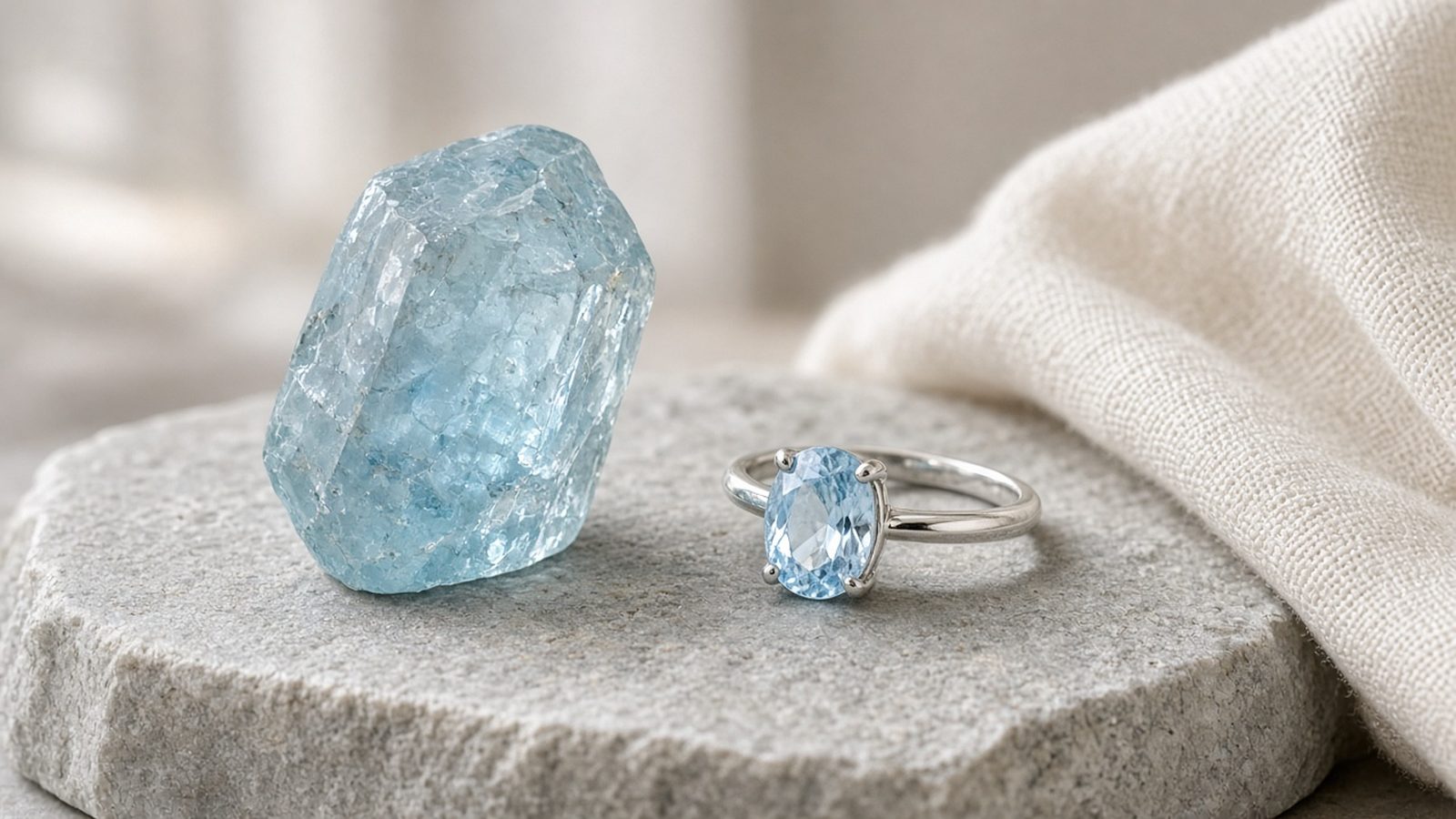
March has two birthstones. Aquamarine, the sea-blue variety of beryl, is the modern favorite: clear, bright and hard enough for everyday rings. Bloodstone, a dark green stone flecked with red, is the traditional alternate, long used in signet rings. They look nothing alike, so pick the one that matches the person.
This guide covers aquamarine color, “Santa Maria” and “sky blue,” heat treatment, blue topaz, glass and synthetic spinel look-alikes, and bloodstone, then ends with a checklist and seven pieces we checked live today. More birthdays to shop for? See our January guide to garnet, our February guide to amethyst, and our December guide to turquoise, tanzanite and blue zircon.
As an Amazon Associate I earn from qualifying purchases. Glimmerjam may also earn commissions from other retailers; see our affiliate disclosure.
Aquamarine at a glance
- What it is: the green-blue to blue variety of the mineral beryl. Emerald is the green variety of the same mineral (GIA).
- Where the color comes from: trace amounts of iron, according to the International Gem Society (IGS).
- Hardness: 7.5 to 8 on the Mohs scale, which GIA says is durable enough for everyday wear.
- Typical color: most aquamarine is a light greenish blue. The most valuable color is a dark blue to slightly greenish blue with moderately strong intensity (GIA quality factors).
- Main treatment: heat, used to remove the green and leave a purer blue.
- Meaning and lore: the name comes from the Latin for seawater, and sailors believed it calmed waves and kept them safe at sea. Aquamarine is also the gem of the 19th wedding anniversary.
Aquamarine color: what to look for
Color drives aquamarine’s value. GIA’s aquamarine quality factors describe a narrow range: blue, very slightly greenish blue, greenish blue, very strongly greenish blue, or green-blue. In general, the purer and more intense the blue, the more valuable the stone. Most aquamarine on the market is light in tone, and the IGS notes you will rarely see one darker than Swiss blue topaz.
Size changes the color you see
Aquamarine’s color deepens with size. GIA notes that faceted stones generally have to be fairly large, over about 5 carats, to show an intense, dark color. The exception is material from some African mines, including Nigeria, Madagascar and Mozambique, which is known for intense color under 5 carats. So small aquamarines in studs or dainty pendants look pale and icy. That’s normal, not a defect.
Greenish or pure blue?
Both are real aquamarine. Pure blue sells for more, but the IGS March birthstone guide notes there is a market for seawater blue-green stones, which may remain untreated. For an ocean lover, a slightly greenish stone can be the more meaningful choice.
Trade names: Santa Maria, “sky blue,” and other labels
- Santa Maria: the IGS lists “Santa Maria aquamarine” as a trade name for a medium-dark, highly saturated blue. It is named after Brazil’s Santa Maria de Itabira mine, but similar color has been found elsewhere. Today it describes a color more than a mine.
- “Brazilian” and “Madagascar”: per the IGS, these names may refer only to color (bluish green and fine medium blue). Don’t assume origin without documentation.
- “White aquamarine”: the IGS says these are most likely colorless beryl, called goshenite. Not aquamarine.
- Maxixe: a very dark blue irradiated beryl that appeared on the market in the 1970s; its color fades. It has mostly left the market, but the IGS advises caution with any unusually deep blue “aquamarine.”
Heat treatment: normal, permanent, and expected
GIA states plainly that most of the aquamarine on the market was heat treated to give it more of a pure blue. According to the IGS, most aquamarine comes out of the ground with a greenish tint that disappears when heated to about 375 °C. The treatment can’t be detected, so gem graders describe any pure blue aquamarine as “probably heat treated.”
The IGS March guide says the result is stable and permanent and does not affect durability. “Heat treated” on a listing is honest disclosure, not a warning sign; if a listing says nothing, assume a pure blue stone was probably heated.
Lab-created, simulated, and look-alike stones
Aquamarine has competition. GIA’s quality factors page notes that aquamarine competes with treated blue topaz in the commercial market, and that fine aquamarine sells for far more than blue topaz of equivalent quality. Here’s what else you may run into:
- Synthetic (lab-created) aquamarine: the IGS says aquamarine can be synthesized, and professional labs have instruments that can separate natural from created stones.
- Sky blue topaz: the IGS guide to aquamarine imitations explains that this popular, inexpensive stone starts as colorless topaz and turns aqua blue after radiation and heat treatment. It is often used to imitate aquamarine.
- Synthetic blue spinel and glass: the IGS lists both among aquamarine imitations. Gem dealer Edelsteine.at notes that aquamarine-colored synthetic spinel is often wrongly sold as “synthetic aquamarine,” and that a gemologist can spot it quickly: spinel is singly refractive, which shows up with an inexpensive dichroscope, and it turns slightly pinkish under a Chelsea color filter.
- Others: the IGS also lists blue CZ, blue zircon, blue tourmaline, blue apatite and plastic.
When you shop: look for “simulated,” “created” or “lab-created” in both the title and the spec table. Today we skipped several sterling listings whose spec tables said simulated while their bullet points described heat-treated aquamarine. When a listing contradicts itself, move on or ask the seller.
Clarity and cut
- Expect eye-clean. GIA says most faceted aquamarines are eye-clean. Some crystals contain liquid inclusions, but stones with eye-visible inclusions are usually cut into cabochons, beads or carvings instead.
- Don’t settle for a poor cut. Because aquamarine is light in color, cutting matters, and GIA notes well-cut gems are fairly common. The IGS agrees there is no reason to buy a poorly cut stone: look for symmetry and lively, even sparkle.
- Shapes: emerald cuts and round or oval brilliants are most common; the IGS notes a deep emerald cut helps intensify color.
Where aquamarine comes from
Brazil’s Minas Gerais has been an important source for two centuries, according to GIA, along with Pakistan’s Karakoram foothills and several African countries, including Nigeria, Madagascar and Mozambique. It is also Colorado’s state gem. The IGS adds that China has become the main source of low-cost, small, pale gems. Mass-market listings rarely state origin.
How durable is aquamarine?
At 7.5 to 8 on the Mohs scale, aquamarine is a tough everyday gem; the IGS notes some people even choose it for engagement rings, though it isn’t as hard as diamond or sapphire.
- Rings are fine for everyday wear. The IGS notes that cut-corner shapes and protective settings, such as a bezel or halo, help aquamarine resist chips. For stacking ideas, see how to stack rings.
Which metal looks best with aquamarine?
- White metals (sterling silver, white gold, platinum) are the classic choice. The IGS notes aquamarine is frequently set in white metals to highlight its light blue.
- Rose gold warms the stone. The IGS notes rose gold can enhance the apparent green in an aquamarine, which flatters seawater-colored stones.
- Yellow gold is a matter of taste: it gives a warm, vintage contrast against pale blue.
- Layering: a small aquamarine pendant on an 18-inch chain is easy to layer. See how to layer necklaces for lengths that work together.
Bloodstone: March’s traditional birthstone
Bloodstone, also called heliotrope, is a variety of chalcedony (cryptocrystalline quartz). GIA describes it as semi-translucent to opaque dark green with red spots of iron oxide, especially hematite. The name heliotrope comes from an ancient Greek word meaning “to turn the sun.” Bloodstone has been a modern March birthstone since 1912, according to Geology.com.
- Best look: Geology.com says the most highly regarded bloodstone has a solid deep forest-green base with a light spatter of sharply contrasting, clearly visible blood-red dots. Stones with this ideal pattern are rare.
- “Fancy jasper”: when white, yellow, orange or brown markings outweigh the red, the stone is usually sold as fancy jasper instead.
- Cut: almost always a cabochon; faceted bloodstone is unusual.
- Source: most bloodstone on the market today is from India, with other sources including Brazil, Australia, China and the United States (GIA).
- Style: historically a men’s stone, per Geology.com, often cut for signet rings; still popular in men’s rings and cufflinks.
- Lore: long worn as a talisman for strength and health; Geology.com notes there is no scientific evidence for healing claims.
Durability and care: bloodstone is softer than aquamarine, about 6.5 to 7 on the Mohs scale (GIA). Clean it with warm soapy water and a soft brush, keep it away from harsh chemicals and very hot temperatures, dry it with a soft cloth, and store it in soft fabric so it doesn’t get scratched.
A buying checklist
- Choose aquamarine (pure blue or seawater blue-green; small stones look paler) or bloodstone (earthy and bold).
- Read both the title and the spec table. Look for “natural,” “heat treated,” “simulated” or “lab-created,” and skip listings where they contradict each other.
- Treat “Santa Maria,” “sky blue” and grades like AAA as seller descriptions, not certified grades.
- Check accents: “white zirconia” or cubic zirconia is not diamond, and total carat weight may include it.
- Check the metal (925 sterling silver, 10K or 14K gold), whether a chain is included, the earring backs and the ring size.
- Check the delivery estimate and return window before the holidays.
Our picks
These listings were checked live today. Links go straight to Amazon with our Associates tag. We don’t list prices here, so check the product page for the current offer. Each description is based only on what the listing itself states, including treatment wording and any conflicts we found.
1. Gem Stone King 925 Sterling Silver Round Aquamarine Stud Earrings (6 mm, 1.50 cttw)
A simple pair of 6 mm round sky blue aquamarines, listed at 1.50 carats total weight, prong-set in 925 sterling silver with a 925 stamp. The spec table lists the stones as natural and heat treated, with a minimum clarity of VS2. Note: the bullet points describe a post with friction back, while the spec table says push back; both describe a standard stud post.
Best for: a classic, everyday March birthstone gift
2. Gem Stone King 925 Sterling Silver Bezel-Set Round Aquamarine Stud Earrings (6 mm, 1.50 cttw)
The same 6 mm size and 1.50 carats total weight, but bezel-set: a rim of sterling silver wraps each stone, which protects the edges and gives a sleek, modern look. The listing calls them heat-treated sky blue aquamarine, and the spec table lists the stones as natural with a minimum clarity of VS2. The same friction-back vs. push-back wording appears here.
Best for: minimalists, men, or anyone who is hard on earrings
3. Gem Stone King Oval Sky Blue Aquamarine Halo Ring, 925 Sterling Silver (1.35 cttw)
An oval sky blue aquamarine in a prong setting, surrounded by a halo of small cubic zirconia accents (not diamonds), in 925 sterling silver. Notes: the title gives 1.35 carats as a total weight, and the spec table lists the gem types as aquamarine and cubic zirconia with a stone weight of 0.75 carats, while one bullet point describes the aquamarine itself as “totaling 1.35 carats.” Don’t assume the center stone alone is 1.35 carats. The page says natural and doesn’t state a treatment. It opened on size 6 for us, with sizes 5 through 9 available, so select your ring size before you add it to the cart.
Best for: a sparkly March birthday or 19th-anniversary ring
4. Gem Stone King Oval Aquamarine Pendant in 925 Sterling Silver and 10K Yellow Gold, 18-Inch Chain (8×6 mm, 1.20 ct)
An 8×6 mm oval heat-treated sky blue aquamarine, listed at 1.20 carats, in a two-tone pendant made of 10K yellow gold and 925 sterling silver. It comes with an 18-inch cable chain with a spring-ring clasp. The listing doesn’t say which parts are gold and which are silver, and it doesn’t state whether the stone is natural or lab-created.
Best for: someone who likes a touch of gold without an all-gold budget
5. Direct-Jewelry 14K Yellow Gold Round Aquamarine Pendant with 18-Inch Chain (5 mm)
A 5 mm round aquamarine, listed at 0.29 carats, prong-set in solid 14K yellow gold, with an 18-inch 14K gold cable chain and a spring-ring clasp included. The description calls the stone genuine natural aquamarine and doesn’t state a treatment. At this size, expect a light, delicate blue rather than a deep one (see the size note above).
Best for: a dainty solid-gold gift that layers easily
6. Silver Palace Natural Oval Bloodstone Ring, 925 Sterling Silver Beaded Split Shank
A large oval bloodstone cabochon, listed at 12×24 mm and 15 carats, bezel-set on a beaded split-shank band in 925 sterling silver. The listing calls the stone natural, describes its color as deep green with flecks of orange and red, and notes that each stone differs from the photo. The page opened on size 5 for us, with sizes 5 through 12 including half sizes, so select your size. When we checked, the delivery estimate was in early to mid December, so order early for a holiday gift.
Best for: a bold, earthy statement ring for a March birthday
7. AWNL Men’s Bloodstone Pendant Necklace, Sterling Silver Frame, 24-Inch Stainless Steel Chain
A men’s pendant that sets a bloodstone, which the listing describes as natural Nepal bloodstone, in a 925 sterling silver frame with an Om symbol design. It comes on a 24-inch stainless steel chain with a lobster clasp. Notes: the subtitle calls the pendant octagonal, while the spec table lists the stone shape as hexagonal, so check the photos. It is an Amazon Handmade item; at the time we checked it was in stock and returnable.
Best for: a meaningful March birthstone gift for him
Caring for aquamarine jewelry
- Warm water, mild dish soap and a soft toothbrush are the everyday method. GIA suggests scrubbing behind the stone, where dirt collects.
- Ultrasonic and steam cleaning are usually safe if the stone has no fractures or liquid inclusions, per GIA; the IGS suggests asking a gemologist first. When in doubt, use soap and water.
- Bloodstone gets soap and water only, no harsh chemicals or high heat.
Want to go deeper? GIA’s pages on aquamarine and the March birthstones cover history and famous stones, like the 10,363-carat Dom Pedro aquamarine at the Smithsonian.
Quick answers
What is the birthstone for March?
March has two: aquamarine, the modern choice, and bloodstone, the traditional alternate.
Is most aquamarine heat treated?
Yes. GIA says most aquamarine on the market was heated to make it a purer blue. The result is permanent, so a “heat treated” label is normal disclosure, not a warning sign.
What is Santa Maria aquamarine?
A trade name for medium-dark, highly saturated blue aquamarine, named after the Brazilian mine where it was first found. Today it describes the color, not necessarily the mine.
How can I tell aquamarine from blue topaz or glass?
Often not by eye, but a gemologist can separate them quickly with simple tools. When buying, watch for “simulated” or “topaz” in the listing.
Is bloodstone a good everyday stone?
It’s fine for pendants and men’s rings with some care. It is softer than aquamarine (about 6.5 to 7 on the Mohs scale), so store it in soft fabric and avoid harsh chemicals and heat.