
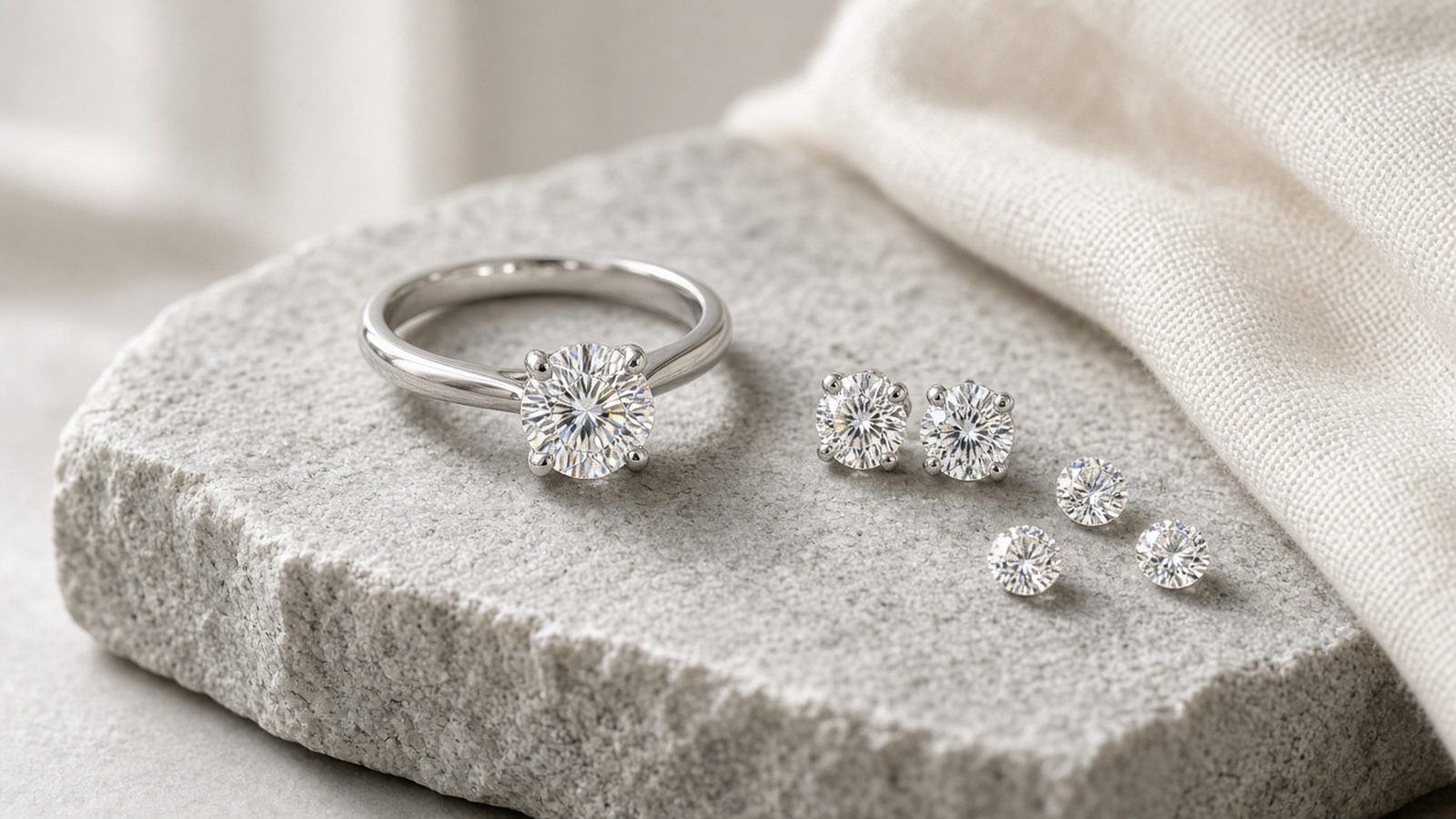
April’s birthstone is diamond, and shopping for one can be confusing: the same sparkly stud might be a mined diamond, a lab-grown diamond, moissanite, white sapphire or cubic zirconia. Most birthday gifts also use small stones, which changes what matters.
Below: the 4Cs for small diamonds, U.S. labeling rules, look-alikes, treatments and care, then seven pieces we checked live today. Shopping for another month? See our January garnet guide, our February amethyst guide, and our March guide to aquamarine and bloodstone.
As an Amazon Associate I earn from qualifying purchases. Glimmerjam may also earn commissions from other retailers; see our affiliate disclosure.
Diamond at a glance
- What it is: the only gem made of a single element, carbon, according to the International Gem Society (IGS). U.S. jewelry rules define it as essentially pure carbon crystallized in the isometric system (FTC Jewelry Guides, 16 CFR 23.12).
- Hardness: 10 on the Mohs scale, the top of the scale (GIA).
- Weak spot: toughness. The IGS notes diamonds can chip at the girdle, culet and sharp points, or split along a cleavage plane.
- Color: about 98 percent of natural diamonds are in the colorless range; the rest are “fancy” colors (IGS).
- Name and lore: the name comes from the Greek adamas, meaning “invincible” or “unbreakable.” GIA traces the first recorded diamond engagement ring to 1477.
- Anniversaries: diamond is the traditional gift for the 60th and 75th wedding anniversaries, according to both GIA and the IGS.
The 4Cs, scaled down for birthstone jewelry
GIA developed the grading system built on four factors (color, clarity, cut and carat weight) in the 1950s (GIA quality factors). Here is how they apply to studs and pavé.
Color: D-to-Z, and how metal changes it
GIA grades color from D (colorless) to Z; the closer to colorless, the higher the per-carat price. Gift-level jewelry usually lists G-H, I-J or lower. The IGS points out that diamonds pick up color from their surroundings, so yellow or rose gold makes a stone look warmer.
GIA adds that about 35 percent of gem diamonds fluoresce, usually blue; it can make a slightly yellow stone look whiter in sunlight, but very strong fluorescence can look cloudy.
Clarity: what I1, I2 and I3 really mean
GIA’s 11 clarity grades run from Flawless and Internally Flawless through VVS, VS and SI to three Included (I) grades, where inclusions can be easy to see without magnification.
Many affordable accent pieces list I2 or I3. That’s honest disclosure: in a cluster of tiny stones you are buying overall sparkle, not crystal-clear individual diamonds. The IGS suggests most buyers aim for a stone that is mostly or completely eye-clean, and notes that “salt and pepper” diamonds make visible inclusions the point.
Cut: the C not to compromise on
GIA describes cut in terms of brightness, fire and scintillation; generally, the higher the cut grade, the brighter the diamond.
Watch the words “brilliant” and “full cut.” Under the FTC Jewelry Guides (16 CFR 23.17), those unqualified terms should be used only for a round diamond with at least 32 facets plus the table above the girdle and at least 24 facets below. The guides say “brilliant” shouldn’t be applied to single-cut or rose-cut diamonds, so a “single cut” accent isn’t a brilliant.
Carat weight: read “cttw” carefully
- Carat vs. points: one carat is 0.2 gram and is divided into 100 points (GIA). The FTC says a weight in points should also be shown as a decimal of a carat, such as “25 points or .25 carat” (16 CFR 23.18).
- Total weight: “cttw” is the combined weight of every diamond in the piece, so 1/4 cttw studs are two stones of about 1/8 carat each.
- Fractions aren’t exact: if a seller states weight as a fraction like 1/4 carat, the FTC guides say they should disclose that the weight isn’t exact and give the range or tolerance being used. We didn’t see a tolerance on today’s picks, so treat fractions as approximate.
- Magic sizes: GIA and the IGS note prices jump at round weights like a half carat; a stone just under looks the same.
- Bigger costs more per carat: GIA notes one 1-carat diamond is worth far more than four 0.25-carat stones of the same quality.
Natural vs. lab-grown diamonds
Lab-grown diamonds are real diamonds made in a laboratory rather than mined. The IGS lab-grown diamond FAQ says they are chemically, physically and optically identical to natural diamonds, with the same Mohs hardness of 10, and that two processes make jewelry-quality stones: HPHT (high pressure, high temperature) and CVD (chemical vapor deposition). The difference is origin.
- You can’t tell by looking. The IGS says no one can tell natural from lab-grown just by looking.
- A “diamond tester” won’t help either. Lab-grown diamonds have the same thermal and electrical conductivity as mined diamonds, so they pass a standard diamond tester, per the IGS FAQ. Only a gemological laboratory can be certain.
- Look for an inscription. Many lab-grown diamonds carry a laser inscription on the girdle identifying them as lab-made, and some carry a report number you can look up online (IGS). GIA laser-inscribes the girdles of diamonds it identifies as laboratory-grown or HPHT-processed.
- Value: the IGS notes lab-created diamonds are less valuable than natural ones, and that most diamonds lose value once bought, so buy what you love.
What the FTC says about “lab-grown,” “simulated” and “natural”
The FTC’s Jewelry Guides set out what U.S. sellers should say. In plain English:
- Lab-created stones must say so up front. A stone name or the words “gem” or “birthstone” used for a lab-grown, synthetic, imitation or simulated stone should be immediately preceded, with equal conspicuousness, by a word like “laboratory-grown,” “laboratory-created,” “[manufacturer]-created,” “imitation” or “simulated” (16 CFR 23.25). “Faux” is not enough.
- “Cultured” needs a qualifier. “Cultured diamond” is acceptable for a lab-created diamond only with a clear disclosure such as “laboratory-grown” (16 CFR 23.12).
- “Real,” “genuine” and “natural” shouldn’t be used for anything manufactured or produced artificially (16 CFR 23.27).
- “Lab-grown [stone]” only for the real thing. Words like “laboratory-grown” or “synthetic” should be paired with a natural stone’s name only if the product has essentially the same optical, physical and chemical properties as that stone (23.25). Moissanite and cubic zirconia don’t have diamond’s properties, so a listing that calls moissanite a “lab-grown diamond” is mislabeled.
- “Flawless” means no flaws visible at 10x to a skilled grader (16 CFR 23.13).
On Amazon, check the spec table’s “Stone Creation Method.” Today’s natural picks said Natural, lab-grown picks Synthetic, and moissanite and CZ Simulated. If title and specs disagree, move on.
Diamond look-alikes, and how listings label them
The IGS guide to diamond alternatives explains that a simulant (look-alike) can be natural or lab-made, and that there is nothing wrong with buying one as long as you know what you’re getting. What it warns against is anyone offering a look-alike as a real diamond.
- Moissanite: the moissanite in jewelry is laboratory-created silicon carbide, made to serve as a diamond simulant; natural moissanite is too rare for jewelry (IGS moissanite vs. diamond). It is 9.25 on the Mohs scale and typically shows more fire than diamond; “classic” moissanite looks yellowish, newer material is sold in colorless grades, and jewelers separate it from diamond with a conductivity-based moissanite tester and a loupe.
- White sapphire: colorless corundum, 9 on the Mohs scale, mined or lab-grown (IGS white sapphire vs. diamond). The IGS says a well-cut diamond will always out-sparkle it; white sapphire has a softer glow, many look milky, and differences show more in larger sizes.
- Cubic zirconia (CZ): the IGS calls lab-made CZ the most popular diamond look-alike. It can rival diamond’s brilliance and fire at a fraction of the price, but it is more likely to scratch or break and, being somewhat porous, absorbs skin oils and dulls over time (IGS).
- Others: colorless topaz, natural zircon and glass (IGS).
Watch for “D color VVS1 moissanite”: diamond grading terms borrowed for a different material.
Diamond treatments: what has to be disclosed
Some diamonds are treated to improve color or clarity, by laser drilling, fracture filling, HPHT processing or coating. GIA explains how it handles them:
- Stable treatments (laser drilling and HPHT processing): GIA may grade the stone but prominently discloses the treatment on the report.
- Unstable treatments (fracture filling and coating): GIA doesn’t issue grading reports for these, or for simulants.
- The legal side: under 16 CFR 23.24 (applied to diamonds by 23.14), sellers should disclose a treatment that isn’t permanent, needs special care, or significantly affects value, and online it belongs in the product description.
The IGS diamond certification FAQ adds that a lab report states whether a diamond is mined or lab-made and whether it was HPHT-treated or laser-drilled, and that grades are expert opinions, not facts. On Amazon, check the “Stone Treatment Method” field, and read “clarity enhanced” as treated.
Metals, settings and styles
- White gold and platinum show off the most colorless grades; yellow and rose gold make diamonds look warmer, which some buyers prefer (IGS).
- Solid vs. plated: “18K gold over sterling silver” is gold plating on silver, not solid gold.
- Earring backs: several of today’s listings name two different back types on one page, so check the photos.
- Protect the edges: the IGS notes diamonds are most vulnerable at the girdle and points, and points to prongs guarding princess-cut corners.
- Stack and layer: see how to stack rings and how to layer necklaces.
A buying checklist
- Decide on natural diamond, lab-grown diamond, or a clearly labeled look-alike (moissanite, white sapphire, CZ).
- Find “natural,” “lab-grown/synthetic” or “simulated” in the title and the spec table. Skip listings where they disagree.
- Read color and clarity as ranges; for small accents, prioritize cut and sparkle.
- Look for treatment wording (“clarity enhanced,” “HPHT,” “coated,” “heat treated”) and ask if it isn’t clear.
- Check metal (solid 14K or 10K gold vs. plated silver), earring backs, chain length and ring size.
- Check delivery estimates and return windows before the holidays.
Our picks
These listings were checked live today. Links go to Amazon with our Associates tag; check the product page for the current offer. Each description reflects only what the listing states, including any conflicts we found.
1. Vir Jewels 1/4 cttw Natural Diamond Stud Earrings in 14K Yellow Gold (I-J Color, VS2-SI1 Clarity, Screw Backs)
Two round diamonds totaling 1/4 carat in four-prong baskets of 14K yellow gold, with screw backs. The listing calls them natural genuine diamonds, minimum color I-J, and the spec table lists the creation method as natural and the treatment as not treated. The seller says each pair is certified and handcrafted in New York. Notes: the title and bullets give VS2-SI1 clarity, while the spec table’s minimum clarity says only “Slightly Included,” and the spec table lists the certificate type as AGS. In stock when we checked.
Best for: a classic natural-diamond April birthday gift in solid gold
2. Amazon Essentials IGI Certified Lab Grown Diamond Solitaire Stud Earrings in 14K Gold (0.25 cttw, G-H Color, VS1-VS2 Clarity)
Two round lab-grown diamonds totaling 0.25 carat in four-prong settings of solid 14K gold, with IGI certification. The page opened on white gold, 0.25 cttw; yellow gold and larger sizes are offered, so check your selection. Specs: G-H color, VS1-VS2 clarity, “Good” cut, push backs. It lists the creation method as synthetic and the treatment method as heat treated.
Best for: someone who wants higher color and clarity grades in a lab-grown diamond
3. Amazon Essentials 1/10 cttw Natural Diamond Circle Pendant Necklace, 18K Yellow Gold over Sterling Silver, 18-Inch Chain
A small open circle with ten diamonds totaling 0.1 carat (I-J color, I3 clarity) on an 18-inch cable chain. The spec table lists the creation method as natural. Notes: the title says “in Sterling Silver,” but the bullets and the version we saw are 18K yellow gold over sterling silver, so this is plated, not solid gold. The spec table also lists the gem type as “agate”; the rest of the page describes diamonds, so we read that as a data error. The listing gives the circle as 2.58 mm wide: very dainty.
Best for: an everyday, layerable April pendant at an accessible level
4. Amazon Essentials IGI Certified Lab Grown Diamond Eternity Band in Solid 14K Gold (0.5 ctw, G-H Color, VS1-VS2 Clarity)
A continuous row of prong-set lab-grown diamonds totaling 0.5 carat in solid 14K gold, with IGI certification; the spec table lists the creation method as synthetic. The page opened on white gold, size 8; sizes run 5 to 8 including halves, so select your size.
Best for: stacking with an engagement ring, or a 60th or 75th anniversary band
5. DYUNQ Moissanite Stud Earrings, 925 Sterling Silver, 4-Prong (Not Diamond)
Clearly labeled moissanite, not diamond: the brand describes moissanite as a lab-created imitation diamond. The page opened on 6.5 mm (listed as 1 carat each), in four-prong sterling silver baskets with a GRA certificate. “D color” and “VVS1” are the seller’s comparison to diamond grades, not a diamond report. Notes: the spec table lists the creation method as “Simulated” and the treatment method as “Lasered,” without explanation. The bullets describe friction backs, while the spec table says push backs.
Best for: maximum sparkle and size on a small budget, as long as the recipient knows it’s moissanite
6. Bruno Magli Men’s Lab Grown Diamond Martini Stud Earring in Sterling Silver (Single Earring)
A single men’s stud (the spec table lists one stone) with a round lab-grown diamond, G-H color and VS clarity, in a sterling silver martini setting. The page opened on 3/4 carat, so check the carat weight, and buy two for a pair. Notes: the description says friction back, while the spec table says push back. In stock when we checked, with a late-November delivery estimate.
Best for: a man who wears one stud, or a lab-grown April gift for him
7. Amazon Essentials Platinum-Plated Sterling Silver Round Cubic Zirconia Stud Earrings (5 mm)
The budget option, clearly cubic zirconia, not diamond: 5 mm round CZ in four-prong baskets of platinum-plated sterling silver, listed as simulated and not treated. Other sizes and princess cuts are offered. Notes: the page uses “butterfly backing,” “friction backs” and “push back” for the same backs, and lists both 1 carat and 1.62 carats as the stone weight. The IGS notes CZ can scratch and dull over time.
Best for: a stand-in pair for travel, gym or second piercings
Caring for diamond jewelry
- Everyday cleaning: warm water, mild soap and a soft toothbrush, or a commercial jewelry cleaner (GIA).
- Ultrasonic cleaners: GIA says diamond is usually durable enough for one, but heavily included or treated diamonds are better cleaned with soap and water or a lint-free cloth.
- Storage: diamonds can scratch other diamonds, so store pieces separately so they don’t rub against each other (IGS).
- Check settings: GIA suggests periodic professional cleaning and setting checks.
GIA’s April birthstone page covers diamond history, including the 3,106-carat rough found in South Africa in 1905 that yielded the Cullinan I.
Quick answers
What is the birthstone for April?
Diamond. It is also the traditional gift for the 60th and 75th wedding anniversaries.
Is a lab-grown diamond a real diamond?
Yes. It is chemically, physically and optically the same as a mined diamond. U.S. rules say it must be clearly labeled “laboratory-grown,” “laboratory-created” or similar, and it shouldn’t be called “natural.”
Is moissanite a lab-grown diamond?
No. Moissanite is lab-created silicon carbide, a diamond simulant. It shouldn’t be sold as diamond.
What do I2 and I3 clarity mean on a listing?
They are the lower “Included” grades on GIA’s scale, meaning inclusions may be visible without magnification.
How can I tell if a diamond has been treated?
Usually not by eye. Look for disclosure in the listing, ask the seller, or rely on a lab report.